

Language for Language Models
Why SKOS Is Required Infrastructure for Enterprise AI

Language models do not know what your words mean. They predict the next token from a distribution learned across a training corpus, and that distribution does not have access to your organization’s decisions specifying where “account” refers to a custodial relationship in one system and a general-ledger entry in another. When a retrieval-augmented system pulls documents that share the surface string “account,” it hands the model everything and lets an LLM improvise the generation of responses. While the improvisation reads well, it is often wrong. This is the problem controlled vocabularies were built to solve, and also why every serious enterprise AI program eventually arrives at the same basic requirements: governed concepts, disambiguated meaning, shared understanding and interoperability to support the cross-system reconciliation of terms.
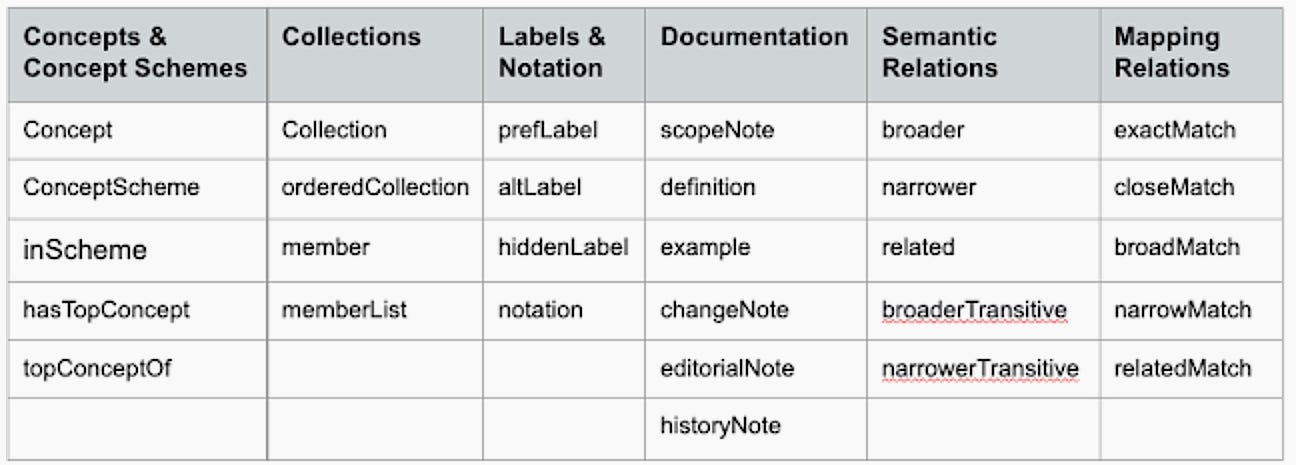
This is where SKOS is the perfect structure and standard to support organizational language and meaning. SKOS — the Simple Knowledge Organization System — became a W3C Recommendation on 18 August 2009.1 It gives an organization a standard way to say that a concept exists, structuring concepts as one preferred label and any number of alternate labels in any language. Plus SKOS is expressed using the Resource Descriptive Framework (RDF), so a SKOS vocabulary is formatted as RDFF triple statements, subject—object—predicate.
SKOS expresses a taxonomy and a thesaurus with broader and narrower concepts, and supports the mapping of concepts between vocabularies through mapping properties such as exactMatch, closeMatch, broadMatch and related links. SKOS is deliberately lightweight. Its designers chose what they called “minimal ontological commitment” so that the world’s thesauri, classification schemes and subject heading systems could be published on the web without first being rebuilt as formal logic.2 That restraint is the reason SKOS scaled to the largest knowledge organization systems on earth, and also why SKOS is a natural fit for an AI pipeline that needs governed meaning without needing a formal reasoner. A formal reasoner is software that derives new facts from an ontology's logic — and it demands strict modeling that extends relationships well beyond a hierarchy and SKOS.
